On 26 January 2024, Bill Henson was made an Officer of the Order of Australia (AO). I generally think less of someone who receives honours from the Australian government, as it is akin to receiving honours from Count Dracula. However, as Henson’s AO is more of an apology from the government and an insult to former Prime Minister Kevin Rudd, I might make an exception.
For some background, read my original blog post about the Rudd-led attempt to criminalise Bill Henson’s art. I wrote a post soon after news of the police seizing Henson’s art broke, which has stood the test of time far better than Rudd’s judgment.
Sixteen years later, there has been a complete backflip by the government, and Henson has been given a government honour. Officially, Henson’s AO was “for distinguished service to the visual arts as a photographer and to the promotion of Australian culture.” This would be the same “Australian culture” that almost every politician in 2008 was willing to destroy for a few minutes of breakfast television virtue signalling.
Perhaps an apology from Kevin Rudd (who is notable for apologising when he could politically capitalise on it) would have been better as it could have been made to not just the harm Rudd did to Henson but also to Olympia Nelson. But as that is not going to happen, it is worth remembering that Rudd was not alone; he was enabled by almost all members of the ALP/LNP cartel. Notably, this included Midnight Oil’s frontman, Peter Garrett, who was posing as Rudd’s Minister for the Arts but lacked the courage and moral fortitude to say anything or even resign. But until an apology is made, I will never forgive or forget what they did or failed to do.
Mic Porter is a Melbourne street artist. He has been painting faces in this style on the building walls in Melbourne using waste/leftover paint for about 20 years. He does faces, nothing else, no other content.
Why is Porter being censored? Port Phillip Council commissioned Porter’s mural on the Carlisle Street shopfront in Balaclava as part of its “People Of Balaclava”. It is now being buffed (painted over) because of complaints about the length of the noses. The nose length was determined in response to architectural form imposed by the nineteenth-century architects (who were probably anti-semitic) who designed the buildings Porter was painting on.
“I have no words”, says Nick Dyrenfurth, who cites as evidence of the mural’s anti-Semitism that Porter has a video of it backed by American singer, songwriter, and civil rights activist Nina Simone’s ‘Backlash Blues’, a song which she co-wrote with Langston Hughes, the American poet, social activist, novelist, playwright, and leader of the Harlem Renaissance.
Zionist Federation of Australia president Jeremy Leibler and Zionism Victoria’s executive director, Zeddy Lawrence, supported the claim in a comment to J-Wire.
Mr. Backlash, Mr. Backlash
Just who do you think I am?
You raise my taxes, freeze my wages
And send my son to Vietnam
You give me second-class houses
And second-class schools
Do you think that all colored folks
Are just second-class fools?
Given this evidence, I am, like Dyrenfurth, lost for words. Donald Trump, accompanied, as always, by a chorus of angels, could not have presented the case more succinctly or definitively.
I tweeted: “Destroying art because someone claims with zero evidence. Does everyone have the right to do this, or do you have to have a special sensitive status? How do you acquire that status?”
A friend replied: “While in principle, I agree, I also feel it is important to listen to minorities when they say something is offensive. I just wish we were more even handed when listening.”
“Sure, I was hoping someone would bring that up because, of course, city councils didn’t listen when Indigenous Australians complained about statues of Captain Cook, etc. I’m assuming their skin was the wrong colour for city councils to listen to them.”
Indigenous people have been complaining about the statue of Captain Cook to Port Phillip Council for many years. Maybe now, Mayor Cunsolo will listen to them, like she does with other groups, because I’m sure she isn’t a racist.
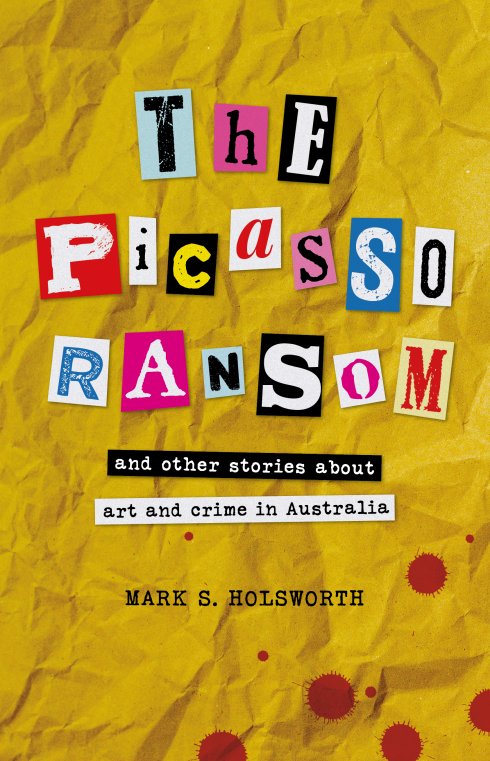
The Picasso Ransom – and other stories about art and crime in Australia, (available in paperback and e-book) my second book is a collection of forty-five true-crime stories about the visual arts in Australia: art theft, art forgery, art censorship, art vandalism, and protest art.
The title comes from the famous artnapping of Picasso’s Weeping Woman from the National Gallery of Victoria. One of the artnapper’s demands was an art prize called “the Picasso Ransom”.
While that crime is famous, others stories of crimes, from the colonial to the contemporary, are not well known but equally intriguing. Amongst them is an entire exhibition of forged Pollocks, paintings stabbed, art prosecuted as pornography, decapitated statues, and more stolen art.
I have long been interested in art crimes and have been building up a file of clippings and photocopies since I first heard Picasso’s Weeping woman was stolen from the NGV in 1986. That year I wrote a long essay on the aesthetic issues of art forgery as part of my undergraduate studies, but don’t worry, I won’t be quoting from it in the book. It is not an academic book, it is a true-crime book, and I now think I was wrong about almost everything I wrote in that essay.
However, my interest kept growing, as did my file on art crimes: newspaper clippings and photocopies about art forgers, iconoclastic vandals and graffiti writers. I read more and attended talks and seminars on forgery and iconoclasm.My interest in Melbourne’s public sculpture, the subject of my first book, introduced me to the theft of bronze sculptures for scrap metal.
Writing a blog is a good way of making contacts and gaining experience in an area. I found myself reporting on the accusations, first against Bill Henson and then, in more detail, against Paul Yore. As well as hanging around with Professor Alison Young, “Banksy’s favourite criminologist”, and graffiti writers and street artists.
When I started writing the book about five or six years ago, I had yet to learn how long it would take or how much work would be involved. I was sitting day after day in the Supreme Court. I conducted interviews and exchanged messages with various people, including convicted forgers, graffiti writers, defence lawyers and courtroom artists (the last two are great for name-dropping infamous criminals).
At first, I thought there might be enough crimes involving art in Melbourne alone to fill a book. From the attempted destruction of Serrano’s Piss Christ, the Liberto forgeries, art stolen from Albert Tucker’s home to the arrest of the American graffiti writer Ether, there was a wide variety of crimes. However, I soon learnt of crimes in other parts of Australia that were too fascinating to leave out. There are some intriguing art thefts in South Australia, the earliest attempt of prosecution for forgery in Sydney, an entire exhibition of fake Jackson Pollock in Perth and more. Adding up to over a century of stealing, forging, vandalising and censoring art around Australia.
So, I hope that you enjoy reading it as much as I enjoyed writing and researching it. And as a thank you to my regular readers the first three people who comment will get a copy sent to them, anywhere in the world.
The Picasso Ransom and other stories about art and crime in Australia
Mark S. Holsworth
ISBN 978-0-646-87307-7 / ISBN 978-0-646-87308-4 (ebook)
314 pages 216×140 (5.5×8.50”)
The Picasso Ransom
Paperback, signed by the author, postage in Australia included.
A$26.99
It is available at, Avenue Bookstore, Readings Doncaster, Readings Carlton, Dymocks Nowra, Amazon and Booktopia.
Given the upcoming exhibition at ACCA, “Paul Yore: Word Made Flesh,” I’ve brought together all my posts on Paul Yore. Most of them are about the police raid on the Like Mike exhibition in the middle of 2013 and the subsequent 2014 trial. There are also two about his 2016 exhibition at Neon Parc.
Paul Yore, Computer World, 2016
My post Gallery Crawl November 2011 records my first encounter with Paul Yore’s art with his exhibition “Monument to the Republic” at Gertrude Contemporary in a single sentence: “Not that there was any deeply political work in any of the galleries or on the street, except for Paul Yore’s ‘Monument to the Republic’ at Gertrude Contemporary, a piss-taking piece of slacker art that represents the Australian Republic perfectly.”
Following the stabbing of Salman Rushdie, do we need reminding that declaring that art is blasphemous directly incites violence? Blasphemy is not a metaphor and has never meant something must be tolerated within the bounds of secular law. No, declarations of blasphemy always encourage violence.
The two sixth-century Buddhas carved into the high sandstone cliffs of Bamiyan of Afghanistan were spectacular survivors from a civilisation that at long passed. They were the tallest standing Buddhas in the world; the first was 55 m, and the second was only an awesome 37 m high.
In March 2001, the Taliban government declared that they were idols, even though they had not been any Buddhists in the area for centuries. They had a plan, a budget and nothing more important to do. When rocket launchers, tank and artillery shells failed to destroy them, they had to do it the hard way, scaling the sculptures and attaching explosives. It took 25 days of work, planting explosives to demolish the statues. Anti-tank mines were laid around the feet to increase the damage the falling stone did.
Mullah Mohammed Omar stated, “Muslims should be proud of smashing idols. It has given praise to Allah that we have destroyed them.”
George Pell (aka Cardinal Pell Pot), Jean-Pierre Cattenoz (aka Archbishop of Vaucluse) and others encouraged the destruction of Andre Serrano’s Piss Christ by declaring it blasphemous. But Pell is not the only senior member of the Vatican to have encouraged the destruction of art by calling it blasphemous. Jorge Mario Bergoglio (aka Pope Francis) also used the word when he was Archbishop of Buenos Aires.
In 2004, Bergoglio demanded a retrospective exhibition of the work of the contemporary Argentinian artist Leon Ferrari, close to end what he called a ‘blasphemous affront’. Bergoglio declared it was blasphemous because of Ferrari’s sculptures of the Virgin Mary in a blender, Jesus crucified on an American bomber, saints in frying pans and other images. Ferrari had long been critical of the Catholic church conniving with the murderous Argentina junta.
Like Pell, Bergoglio also objected to public money being used for the exhibition in a public art gallery. Bergoglio was a tiny bit more successful than Pell. Unlike Pell, he initially got a judge to agree with him and obtained an order for the exhibition to close. However, this was overturned on appeal, and the exhibition was reopened. A mob of the faithful then destroyed several works of art at the exhibition, shouting: “Long live Christ the King!” The artist forgave Bergoglio because he got great free publicity; it is unknown if Bergoglio has forgiven Ferrari.
Forgiveness aside, the question remains should we tolerate religious organisations that call things blasphemous? My long answer is only if they tolerate the arbitrary use of violence against them. So, the short answer is no.
This post is not about Casey Jenkins, a Melbourne based performance artist. I have previously written about two of her work: True Colours (2019) and Body of Work (2015). This post is about the Australia Council for the Arts reneging on an agreement with Jenkins and why this is a concern for everyone in Australia.
Image of part of Casey Jenkins True Colours 2019
There are many conflicting statements made by the Australia Council and Casey Jenkins but what both agree is that the Australia Council is not funding Jenkins current artwork after previously agreeing to. See Casey Jenkins statement and the Australia Council for the Arts statement.
What everyone is also aware of is that the process is unfair because they would not accept it as fair if somebody reneged on an agreement with them. Is the unfairness in any way excusable? Australia Council is using the COVID-19 tragedy as a cover while admitting that their system was at fault. Next time will they use the person responsible “was having a bad day,” one of the recent excuses that NSW police has used for assaulting an Indigenous youth.
I asked the Australia Council about their media statement and if this means that thye take responsibility for the poor quality of the review process? And how has the process regarding variation requests been adjusted?
The Australia Council’s media statement stated that: “The Council has been in contact with the artist to advise we consider it necessary to rescind the variation to the original grant, effectively withdrawing support for this specific project.” How do you unilaterally “rescind” what is essentially a contract between the Australia Council and the artist? Casey Jenkins did not agree to rescind it and so, isn’t the correct word “reneged” and not rescind?
I also asked if artists should be concerned that something similar might happen again when they make a variation request? The Australia Council chose not to reply to my questions while sending me two emails about my enquires.
There is a lot that the Australia Council is not saying about this that should be clarified for future applicants. It could be more open about what subsequent changes to its process it has made. It could release the legal advice on Jenkins art. It could even acknowledge the history of Australian politicians interfering in arts, and admonish all attempts, rather than merely deny that any occurred in this particular case. Instead it has chosen instead to protect politicians and damage the arts in Australia by denials and increasing uncertainty.
No system or Australia Council review process can predict what Australian politicians will want to censor because censorship is an arbitrary act of power. And every few years Australian artist is attacked as immoral by a conservative politician; it is a tradition going back to Federation. It is so common that I have a category in this blog for posts about art censorship.
I felt little for the majority of the sixty-three sculptures on exhibition. It is difficult to be daring when there are so many technical challenges and expenses to making sculpture. Consequently many are like a large piece of jewellery — well designed and made but too boring, slick and trite to be anything other than ersatz art. Stuff so bland that zombie formalism looked thoughtful. There were a few made me wince as their combination of materials was the visual equivalent of ice-cream with pickles. There were, of course, a couple of kitsch pieces and one case of questionable cultural appropriation.
Michael Meszaros, Smouder
Finally there were some sculptures that were appealing for various reasons; not bad for a group exhibition. I was surprised when I checked who was the artist of some of the works that caught my eye: Drasko (who I know from his street art and art transport business) and Michael Meszaros (who has done many public sculptures). Meszaros’s wavy bronze piece, Smoulder, is like curls of smoke. Drasko Boljevic’s Baby is almost a minimal comic-book version of Munch’s Scream.
Drasko Boljevic, Baby
Tahani Shamroukh’s A Labour is one of the few pieces of contemporary art in the exhibition and one of the few that had anything to say. It is realism; it doesn’t look like anything other than what it is and it is life. A cube of used work clothes and boots, the kind that labours wear, is as real as the $5 bill amongst them. It reminded me of Ai Weiwei’s Ton of Tea (2011), a one square metre block of compressed oolong tea. I was not surprised that Shamroukh’s A Labour won the Art Almanac Prize.
The Association of Sculptors of Victoria 2019 Annual Awards and Exhibition is at Collins Square, an enormous multi-towered building in the Docklands with a network of foyer areas almost the size of a city block. The foyer works well as an exhibition space for the sculptures. They need this kind of space for their work, not just because some of it is large and heavy, but because it is impressive semi-formal space with an instant audience. The kind of place with marble floors and a paintings the size of sail by John Olsen hanging at the top of one staircase with a painting of the city by Ricky Kasso above another.
Collins Square is also the kind of place that is professionally managed and this has resulted in a peculiar decision to ban one sculpture from the exhibition. The story of the sculpture’s censorship has legs even if the bust of a man didn’t; from Channel 7 to the Sydney Morning Herald and other media outlets. I don’t blame the Collins Square management for their crazy decision because Australia’s culture of censorship is arbitrary, inexplicable and the consequences for even minor transgressions can be sever. There has been a censorship controversy over images of male nipples in the past, Del Kathryn Barton’s son’s bare chest in 2011, and it could happen again because in this country the irrational is privileged over reason, ethics and taste.


 Black Mark